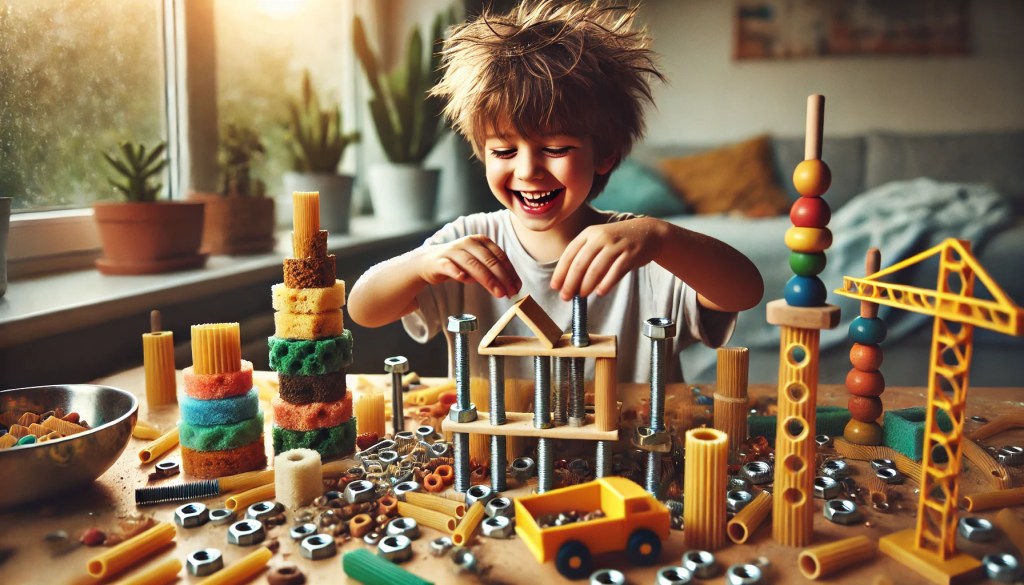
I first came across play-based learning while studying for my teaching degree at the School of the Art Institute of Chicago. One particular moment that solidified my interest was during a hands-on workshop where we were encouraged to engage with art materials in an unstructured, exploratory way—much like young children do. I remember feeling both liberated and challenged, realizing that the absence of rigid expectations allowed for deeper creativity. This experience made me curious about how structured education could integrate more play, leading me to explore the Reggio Emilia approach and its emphasis on child-led discovery. This philosophy deeply resonated with me, as I had always been fascinated by how young children learn through pretend play.
Commonly known pretend-play games like playing house, setting up a restaurant, or engaging in imaginary war games are great examples of how children learn by observing and mimicking their surroundings. They take on roles, create rules, and construct narratives, demonstrating their ability to make sense of the world. We often say young children’s magic power is their imagination, and I truly saw this in action during a Reggio Emilia group project in my studies.
The Reggio Emilia approach is a philosophy of early childhood education that emphasizes child-led exploration, collaboration, and creativity. It views children as capable, curious learners who construct their understanding of the world through hands-on experiences. In an art classroom, this translates to an environment rich in materials and opportunities for discovery, where students are encouraged to express their ideas through various artistic mediums.
Key principles of the Reggio Emilia approach in an art setting include:
- The Environment as the Third Teacher – A thoughtfully designed classroom with accessible art materials encourages independent exploration.
- Inquiry-Based Learning – Students are guided by their curiosity, leading their own creative projects rather than following step-by-step instructions.
- Documentation of Learning – Teachers observe, photograph, and record students’ artistic processes to reflect on their growth and creativity.
- Collaboration and Communication – Students work together, discussing and developing their ideas through artistic expression.
In my Reggio Emilia group project, my group and I provided a classroom of Grade 1 students with a variety of everyday materials—nuts and bolts, sponges, pasta noodles, beans, and more—without any specific instructions or prompts. Initially, we simply observed how the students interacted with these materials. Recalling their past experiences working with Legos, my Grade 1 students immediately began constructing figurines, forts, and eventually an entire town. We then encouraged them to make up a story and act it out as they told it. To my amazement, most students instantly developed intricate narratives, which would likely be challenging for many adults. This experience led me to research more about young children’s psychological development and the importance of play-based learning.
One of the most valuable aspects of play-based learning is its ability to produce unexpected learning results. For example, during my Reggio Emilia project, I anticipated that students would explore the materials in isolated ways—sorting, stacking, or arranging them in patterns. Instead, they quickly transformed these simple objects into a fully developed town with characters, homes, and a functioning story. This unexpected outcome showcased their ability to think beyond the given parameters. It highlighted their problem-solving skills as they negotiated roles, adapted to each other’s ideas, and built a cohesive narrative. When students are given the freedom to explore, they often make surprising and creative connections that go beyond what a teacher might anticipate. These discoveries highlight children’s depth of thinking, problem-solving abilities, and innate curiosity-driven learning. By allowing for the unpredictable, play-based learning nurtures intrinsic motivation and adaptability—skills critical for success in education and life.
What is Play-Based Learning?
Play-based learning is an educational approach that encourages exploration, experimentation, and creativity through playful experiences. It fosters a sense of curiosity, allowing students to engage with materials and ideas in a natural, enjoyable, and unpressured way. Unlike traditional instruction, which often focuses on structured lessons and expected outcomes, play-based learning embraces open-ended exploration, inviting students to take risks, make discoveries, and develop ideas.
Depending on the age group, play-based learning can take many forms in an art classroom. For younger children, it often includes sensory experiences, free-form painting, collaborative storytelling through drawings, or imaginative role-playing with art materials. Older students may engage in playful exercises that push them to think outside the box, such as surrealist games, improvisational art challenges, or using unconventional tools and materials to create artwork.
Why Play-Based Learning Works for Young Children
Young children’s greatest strength is their boundless imagination. They naturally engage in storytelling, role-playing, and exploration through play. In an art classroom, this translates into activities that allow them to:
- Express their creativity freely – Without rigid expectations, children experiment and discover new artistic approaches.
- Develop storytelling skills – Whether through drawing, painting, or sculpture, young learners narrate ideas and experiences in their own unique ways.
- Enhance problem-solving abilities – Play encourages them to think critically about materials, structures, and visual communication.
- Build confidence – Because there are no “wrong” answers in play-based learning, students feel more comfortable taking creative risks.
The results of play-based learning with young children often go beyond what teachers anticipate. Given the freedom to explore, children make unexpected connections and develop original concepts that exceed adult-imposed limitations. These unpredictable learning outcomes demonstrate that children are capable of thinking in ways that educators might not have considered. By embracing these outcomes, teachers transition from instructors to facilitators, encouraging deeper understanding while fostering student creativity. For example, instead of dictating how a project should unfold, a teacher might introduce open-ended materials and let students experiment freely. By asking reflective questions—such as ‘What happens if you try this?’ or ‘How did you come up with that idea?’—teachers can encourage students to think critically about their own creative process. This approach not only supports student agency but also fosters an environment where learning is a dynamic, student-led experience rather than a rigid, predetermined outcome. This unpredictability encourages flexibility and innovation—key skills that benefit children throughout their lives.
How Play-Based Learning Benefits Older Students
As students grow older, their sense of play often diminishes due to social pressures, fear of failure, and increased academic expectations. Teenagers, in particular, may struggle with self-esteem and creative confidence, often feeling the need to conform or fearing judgment from peers. Play-based learning can serve as a powerful tool to break through these barriers, allowing middle and high school students to:
- Reduce fear of failure – By creating a space where experimentation is valued, students feel more comfortable making mistakes and learning from them.
- Encourage self-expression – Playful activities give students a chance to explore their thoughts and emotions in a low-pressure environment.
- Boost problem-solving and adaptability – Engaging in creative play helps students develop resilience, flexibility, and lateral thinking skills.
- Foster collaboration and social connection – Playful art activities often involve group work, strengthening communication and teamwork skills.
Final Thoughts
Play-based learning is not just for young children—it’s a powerful tool that fosters creativity, confidence, and critical thinking at any age. If you’re an educator looking to incorporate play-based learning in your classroom, start by allowing for more open-ended activities where students can experiment freely. Introduce unconventional materials, encourage risk-taking, and embrace unexpected outcomes. Ask reflective questions that guide students to think critically about their creative process. By fostering exploration and play, educators help students unlock creativity and deepen their connection to learning. Integrating play at all levels nurtures curiosity, encourages innovation, and ensures creativity remains essential in education.


 123ArtAppetit
Leave a comment